About the Johann Peter Mertes Winery
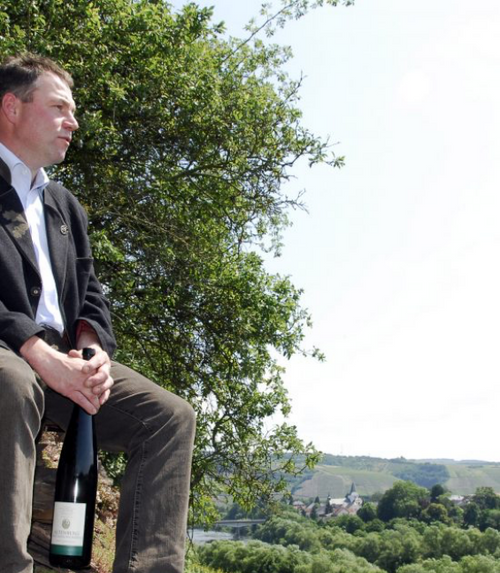
The Johann Peter Mertes winery is located in Kanzem, opposite the majestic steep slope of Kanzemer Altenberg, on an old arm of the Saar. The wine village of Kanzem is practically situated on a kind of island, because due to the canalization of the Saar in the 1980s, the Saar divides at the Schoden weir into the navigable, straight canal and the old Saar arm, which flows around Kanzem in a large loop. The Mertes family has been cultivating wine at this idyllic spot since 1891. Today, the winery is run by Johann Peter Mertes, the fifth generation. The profession of winemaker was practically in his cradle. After school, he completed an apprenticeship as a winemaker, followed by viticulture studies at the renowned University of Applied Sciences in Geisenheim. Consequently, in 1992, he took over his father's business and was able to apply his acquired know-how and expand the operation. Today, the winery cultivates approximately 12 hectares of vines in famous steep slopes in Kanzem, Wawern, Saarburg, and Ockfen. One of the most impressive vineyards on the Saar is the Kanzemer Altenberg. J.P. Mertes' "home mountain" is the largest continuous steep slope in Europe. The longest rows are over 250 vines long, and the site is incredibly steep. The unique microclimate in the immediate vicinity of the old Saar arm, as well as the heavily weathered, relatively deep slate weathering soil with a high proportion of red slate, produces powerful, well-structured wines with fruity aromatics and mild acidity. In contrast, Johann Peter Mertes' Rieslings from Ockfener Bockstein, also a world-famous vineyard characterized by coarse greywacke and Devonian slate soils, are livelier and particularly show their strengths in the off-dry taste profile. The vineyard portfolio is completed by parcels in Wawerner Goldberg and Wawerner Ritterpfad, two comparatively warm vineyards with deeper slate soils, as well as the Saarburger Stirn monopole, which is exclusively owned by the winery. The above-average quality of Johann Peter Mertes' wines has not gone unnoticed by the relevant wine guides. The winery is rated with 2 grapes in Gault & Millau and 2 stars in Eichelmann, and Feinschmecker has ranked the winery among the best in Germany since 2016/17! In addition to the excellent wines, the winery has also made a name for itself with classic fruit brandies from its own distillery.
"Handwork as a Key to Success"
In managing his vines, Johann Peter Mertes relies on a combination of traditional winemaking craftsmanship and modern technology. Despite technical support, a great deal of manual labor is still required throughout the year, for example, to prune the vines. Today, the winery cultivates 100% Riesling. In autumn, the grapes are selectively hand-picked and then taken to the press. There, depending on the wine and vintage, it is decided whether the grapes are pressed whole directly or first macerated for several hours. The must is traditionally allowed to sediment overnight to separate it from coarse solids. The next morning, the now clear must is filled into stainless steel tanks and fermented with natural yeasts to preserve the fresh fruit aromas of the wines and to highlight the characteristics of the individual vineyards.
"Invigorating, easy-drinking Rieslings with mellow acidity"
This approach produces stimulating white wines with pronounced fruit aromas that promise great drinking pleasure! The wines consistently display great balance and rather mild acidity, making them uncomplicated everyday wines and excellent food companions! They are quite approachable immediately after bottling, but also possess considerable aging potential, as a recent, perfectly fresh bottle of Kanzemer Altenberg Auslese 2010 impressively confirmed.
 Delivery time 2-3 working days
 Saar wines at winemaker prices
 Largest Saar wine range on the web
 Advice: 0176 638 92254