 Delivery time 2-3 working days
 Saar wines at winemaker prices
 Largest Saar wine range on the web
 Advice: 0176 638 92254
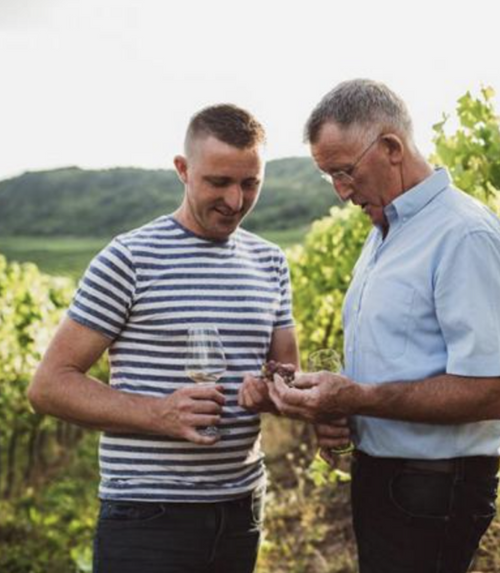
Peter Greif
Peter Greif: The Elbling specialist with a passion for Saar wine
Weingut Peter Greif - the Elbling specialist with a passion for Saar Riesling. Elbling is his specialty - Riesling from the Saar his passion. His Roter Elbling feinherb 2018 was voted audience favorite at the Klang & Glanz Festival. Fruit-driven wines with an outstanding price-pleasure ratio.
Here you can get the wines of Saarkind Peter Greif!
Peter Greif: The Elbling specialist with a passion for Saar wine
Weingut Peter Greif - the Elbling specialist with a passion for Saar Riesling. Elbling is his specialty - Riesling from the Saar his passion. His Roter Elbling feinherb 2018 was voted audience favorite at the Klang & Glanz Festival. Fruit-driven wines with an outstanding price-pleasure ratio.
Here you can get the wines of Saarkind Peter Greif!


About the Peter Greif Winery
The Peter Greif winery is located in Fellerich, a small district of Tawern. Here, in the tri-border region between Germany, France, and Luxembourg, the small wine village of Fellerich is situated on a hill. Excavations have revealed that the Romans already cultivated wine here. It's no wonder, as the advantageous geographical location between the Saar and Moselle, combined with the magnificent views over the southern Wine Moselle and excellent sun exposure, make Fellerich an ideal place for viticulture. The Greif family has been cultivating wine here since 1832, now in their third generation. Initially, as was common at the time, it was a mixed farm with viticulture, agriculture, and animal husbandry. However, Peter Greif Senior and his wife Marilu transformed the former mixed farm over the last 40 years into a pure bottled wine producer with an attached distillery. Since 2017, Peter Greif Junior has been primarily responsible for the business. After training as an agricultural machinery mechanic and then completing his winemaking apprenticeship at the renowned VDP winery von Hövel, he returned to the family business to successively develop it further. Today, the Peter Greif winery cultivates approximately 10 hectares of vineyards on the Upper Moselle and the Saar. These are spread across a total of five sites; two on the Saar (Wawerner Goldberg and Wawerner Ritterpfad) and three on the Upper Moselle (Fellericher Schleidberg, Temmelser St. Georgshof, Oberbilliger Hirtengarten). Typical for wineries in the southern Wine Moselle is the predominant cultivation of Elbling and Burgundy grape varieties, which thrive excellently on the local shell limestone soils. The focus is clearly on white wines. Thus, Elbling, Pinot Gris, Pinot Blanc, Rivaner, and Auxerrois dominate the winery's grape variety spectrum. However, the Peter Greif winery has also been expanding to the Saar for some time, cultivating old Riesling vines in Wawern sites on slate soils. The combination of Elbling and Burgundy grape varieties from the shell limestone soils of the Upper Moselle and Riesling, grown on the steep slate slopes of the Saar, makes the winery particularly appealing!
"Certified by "Ebbes von Hei" and member of SAARKIND"
In addition to these classic white wines, master winemaker Peter Greif Junior also produces "Winzersekt" (sparkling wine made by winemakers) using the traditional bottle fermentation method. But that's not all: besides wine and sparkling wine, other regional specialties such as exquisite fruit brandies from the estate's own distillery, as well as Viez (cider), highly prized in the Trier region, are also part of the winery's range of typical local products. For the Peter Greif winery, the marketing of regional products and the sustainable management of our cultural landscape have always been top priorities. In 2020, this was taken as an opportunity to have the winery certified as the first wine producer in the Rhineland-Palatinate part of the Saar-Hunsrück region by the regional initiative "Ebbes von Hei!" (Something from here). This association works across borders in Rhineland-Palatinate and Saarland in the Saar-Hunsrück region to market small, regional producers with sustainable practices and high quality standards. Furthermore, the winery is a member of "SAARKIND," an association of 10 young winemakers from the Saar, whose goal is to jointly enrich the region with unusual campaigns and events. The winery can also boast other awards. In 2010, it received the State Honorary Award of Rhineland-Palatinate for its excellent fruit brandies, and in 2016, Peter Greif Junior was named Young Winemaker of the Year for Saar-Obermosel at the Konz Wine and Local Heritage Festival!
"Red Elbling, a Regional Specialty"
In the vineyard, the winery works as close to nature as possible. This means that Peter Greif categorically rejects the use of herbicides, such as glyphosate, to strengthen biodiversity in the vineyard. Instead, he relies on mechanical soil cultivation to protect insects and bees and fertilizes his vineyards exclusively with organic fertilizer. During the year, the predominantly newly planted vineyards prove to be a great advantage, as the modern trellis systems ensure good ventilation and sun exposure for the grapes and also allow for quick and precise cultivation – whether by hand or machine. In autumn, the vineyards are harvested either mechanically with state-of-the-art harvesters or selectively by hand, depending on requirements. The grapes are brought to the press as undamaged as possible and immediately pressed. The Rote Elbling is an exception. The grapes come from White Elbling vines. Elbling is a grape variety that tends to natural mutations, and so every year individual vines or just individual grapes turn dark red. These grapes are selected separately and then mashed at the winery. During the maceration period, grape-specific enzymes can release the red pigments from the berry skin, giving the must an intensely red color, even though it is a white grape variety. All wines are left to settle overnight so that coarse lees collect at the bottom of the tank and the clear must above can be separated. This is fermented in stainless steel tanks in the over 200-year-old vaulted cellar. These are neither deacidified nor subjected to malolactic fermentation (MLF) in order to produce fresh and finely fruity wines with wonderful drinkability.
"Audience favorite of the Wiltingen "Klang und Glanz Festival""
Peter Greif's wines are consistently delightful and invigorating to drink, typically featuring zesty acidity and clear fruit aromas. They are uncomplicated everyday wines with high standards that are sure to impress wine drinkers. For example, in 2019, the Peter Greif Roter Elbling feinherb 2018 was the crowd favorite at the Wiltingen "Klang und Glanz Festival," a wine festival organized by the young winemakers' association "SAARKIND."