 Delivery time 2-3 working days
 Saar wines at winemaker prices
 Largest Saar wine range on the web
 Advice: 0176 638 92254
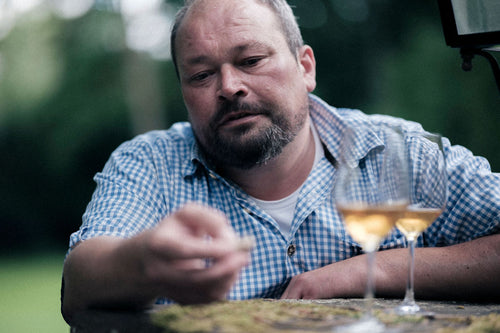
By Othegraven
Von Othegraven Winery - Vinum Winery of the Year 2023!
Since 2010, Günther Jauch, together with his wife Thea and the long-standing team around cellar master Swen Klinger, has been running his Von Othegraven winery in its 7th generation. Expressive, characterful wines with distinctive aromas that captivate you.
Here you can get the wines from Weingut von Othegraven, as always, at winery prices!
Von Othegraven Winery - Vinum Winery of the Year 2023!
Since 2010, Günther Jauch, together with his wife Thea and the long-standing team around cellar master Swen Klinger, has been running his Von Othegraven winery in its 7th generation. Expressive, characterful wines with distinctive aromas that captivate you.
Here you can get the wines from Weingut von Othegraven, as always, at winery prices!


Klein: 95+ / 100
Riesling
fruity
by Othegraven
From Othegraven Altenberg Late Harvest Old Vines 2021
41,33 €
/ l
31,00 €
Tax included

About the Von Othegraven winery
The Von Othegraven winery is located in Kanzem, a small wine village on the lower Saar river. The winery is one of the oldest wineries on the Saar and was a founding member of the VDP Mosel-Saar-Ruwer. Hardly any other winery in Germany has received more media attention in recent years. Since Günther Jauch and his wife Thea took over the winery in 2010, the press has been virtually overflowing with euphoric articles. Of course, critics were quick to point out that the winery, like so many others with prominent support, was merely a nice prestige object. But they were to be proven wrong. The quiet and thoughtful showman did not simply take over just any winery on a whim. Together with his wife, he is following in the footsteps of his ancestors and is now running the Von Othegraven winery in its 7th generation! The vineyard area of 16.5 hectares is spread over four VDP.GROSSE LAGEN – all planted 100% with Riesling. The Kanzemer Altenberg is the largest single vineyard of the winery. With approximately 7 hectares of ownership in the steepest parcels (up to 85% gradient), a large proportion of which are old, ungrafted vines, it is the largest owner in this prestigious steep slope. The Altenberg, with a row length of up to 250m, is the longest steep slope in Europe. With partly more than 250 vines per row, you can imagine that the harvest helpers don't see any light at the end of the tunnel for a long time when they start harvesting early in the morning at the foot of the mountain. The Kanzemer Altenberg is also characterized by its immediate proximity to the Saar and its reddish shimmering, deep slate soil. Here, there is a comparatively warm microclimate, and the high temperatures, as well as the red slate, lead to wines with exotic fruit aromas, restrained acidity, silky texture, and often expressively spicy minerality. In addition to the Altenberg, the winery also owns land in Ockfener Bockstein, Wiltinger Kupp, and is the sole owner of the monopoly site Wawerner Herrenberg. In relevant wine guides such as Gault & Millau, Eichelmann, and Vinum, the winery is highly praised, and the wines are regularly awarded top scores. In particular, the impressive Kabinett collection from all four single vineyards of the winery reaches a level that is unparalleled!
"Günther Jauch - Apprentice in His Own Winery"
To all skeptics who think Günther Jauch merely serves as a prominent advertising face for the winery and only makes occasional press appearances, we can assure you: You are gravely mistaken! He and his wife travel back and forth between their home in Potsdam and beautiful Kanzem all year round and actively pitch in at the winery. Out of 10 times we pick up our wine there, he and/or his wife Thea are certainly on site for over half of those occasions and personally load our wine into the car. Both are exceptionally kind and helpful people without any star airs! Günther Jauch describes himself as an "apprentice in his own winery" and, as someone without any wine training, is therefore overjoyed to have taken over an excellent team of specialists around estate director Andreas Barth from his predecessor, Dr. Heidi Kegel. He enjoys it in the tranquil provincial town of Kanzem because he spent a lot of time at his uncle Max von Othegraven's winery during his childhood. From the very beginning, contact and exchange with fellow winemakers was very important to the Jauchs, and they have exemplary integrated themselves into the circle of Saar VDP members. For example, they revived the annual young wine tasting among VDP colleagues, introduced by their predecessor Dr. Heidi Kegel, and contribute whenever possible to joint events, such as the Saar-Riesling Summer. Günther Jauch's first act in the new winery was the redesign of the labels. The traditional labels with the image of the winery had to go. Today, a striking red "O" crowned by a "v" for von Othegraven adorns all the winery's labels. For this successful relaunch, the winery was awarded the coveted "Red Dot Design Award". Furthermore, Mr. Jauch invested in the estate building, additional utility rooms, and the vineyards. For instance, he had the historic manor house faithfully restored and expanded the winery with a vinotheque and an event space for up to 60 people in the estate park. Today, both the winery and the breathtakingly beautiful English landscape garden with its ancient exotic trees at the foot of the Kanzemer Altenberg are listed buildings. But getting here was a long and rocky road:
»This is how Günther Jauch acquired his winery on the Saar«
Günther Jauch's great-uncle, Emmerich Grach, acquired Weingut von Othegraven in 1805 after purchasing Weingut von Hövel. He bequeathed it to his daughter Katharina Weißebach, who continued the estate under the name J. Weißebach Erben. However, she remained childless, and in 1922 she bequeathed the winery to her nephew Maximilian von Othegraven and his siblings. In the mid-1950s, Maximilian von Othegraven acquired the shares of his sister, Maria von Othegraven, and her husband, Hans Jauch, Günther Jauch's grandfather. From then on, the winery bore the name Maximilian von Othegraven. As he also had no descendants, Dr. Heidi Kegel, an internist from Cologne and niece of Maria von Othegraven, inherited the winery. It was she who re-established the winery for the future, created an innovative dry-tasting brand wine "Maximus," named after the winery's founder Maximilian von Othegraven, and hired the experienced oenologist Andreas Barth as estate director and cellar master. The trained lawyer is considered a proven expert in the industry for vinification with natural yeasts and thus stamped the Othegraven wines with his unmistakable stylistic mark. When rumors of a sale of the winery increased in the late 2000s, a certain Günther Jauch in Potsdam took notice. Many of his fondest childhood memories are linked to vacation visits to Uncle Maximilian von Othegraven. The dreamily beautiful winery, situated at the foot of the Kanzemer Altenberg and on the banks of the Saar Altarm, with its extensive estate park, never left the presenter's mind. Under no circumstances did he want to allow the traditional family winery to fall into the hands of foreign investors. And so, after much consideration, he and his wife decided to take over the winery. Thus, the winery remains in family ownership, even after more than 200 years, and is now run again by a direct descendant of the founder Emmerich Grach, in the 7th generation.
"Swen Klinger - The Lord of Wild Yeasts"
In its vineyards, Weingut von Othegraven employs a nature-oriented cultivation method, foregoing the use of herbicides, insecticides, and artificial fertilizers. However, the winery does not wish to submit to the constraints of organic certification, as it wants to keep open the option of using fungicides in difficult vintages with warm, humid weather. Instead, the winery is a member of the FAIR'N GREEN association. This organization not only focuses on sustainable, environmentally friendly cultivation but also incorporates other factors, such as fair treatment of its employees, in line with a holistic approach. In autumn, the grapes are selectively hand-picked into small tubs and then crushed and pressed at the winery. As a founding member of the Association of German Natural Wine Auctioneers (VDNV), the natural wine philosophy still plays a significant role at Weingut von Othegraven. The experienced cellar master, Swen Klinger, allows all musts to ferment spontaneously, meaning with natural yeasts, in stainless steel tanks or large Stückfässer (large wooden casks). The winery was one of the pioneers of great, dry Saar wines and released one of the first "Große Gewächse" (Grand Cru equivalent) from the Kanzemer Altenberg in the early 2000s. Today, the winery is primarily dedicated to Kabinett wines. Hardly any other winery devotes itself with such dedication and passion to this unique wine style, so typical of the Saar region. During the winemaking process, the wines are given the time they need. Often, the wines continue to ferment until the spring of the year following the harvest and are allowed to mature on their lees until bottling in May/June.
"Rieslings with magnificent aging potential"
The result is a very expressive, unmistakable wine style that may not appeal to everyone at first sip. The smoky aromas of spontaneous fermentation, often reminiscent of gunpowder, are omnipresent and highly valued by the winery's aficionados. These aromas dissipate with age, however, and the remnants further contribute to the complexity and tension of the wines. So, if you are experiencing a young Von Othegraven wine for the first time, give it a large white or even red wine glass, allow it some time, and aerate it in the glass. You are welcome to decant it as well and will be surprised at the magnificent wine that lies beneath the initially often rather restrained bouquet. Thus, the dry estate wine "MAX," successor to "Maximus" and named after the winery founder Maximilian von Othegraven, is a true character wine with subdued fruit and pronounced roasted aromas. It impresses with its excellent structure and mild acidity, making it an outstanding food companion. The Grand Cru wines of the estate are also truly magnificent food companions and are best enjoyed from large Burgundy glasses so that they can unfold perfectly. The Kabinett wines present themselves as very enjoyable right away and possess excellent aging potential.