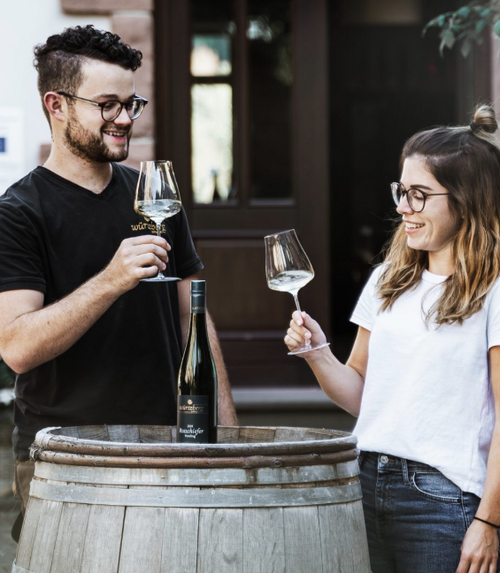
About the Würtzberg Winery
Following the course of the Saar through the Saarland into Rhineland-Palatinate, one encounters the first winery on the Saar, Weingut Würtzberg, at the height of the Serrig lock and weir. It is located in Serrig, a wine village on the upper reaches of the Saar. Here, the Heimes family currently cultivates around 17 hectares of vines in their two monopolistic vineyards, Serriger Herrenberg and Serriger Würtzberg, and since 2019, also in the world-renowned Ockfener Bockstein site. The majority of the vineyard area, 11 hectares, is traditionally planted with Riesling, but the winery is the Burgundy specialist on the Saar, and thus, in addition to Riesling, has also been cultivating 3 hectares of Pinot Blanc since 1980. Furthermore, it was also the first winery on the Saar to plant the French grape variety Auxerrois (named after the French city of Auxerre in Burgundy) on 1.5 hectares. A small amount of Pinot Gris now rounds off the white grape varietal spectrum of the estate. In addition, the Heimes family owns a 1-hectare parcel of Pinot Noir (planted in 1986), which, at 35 years old, is among the oldest on the Saar! These vines are located in a particularly steep and warm parcel of the Serriger Würtzberg. The red, iron-rich slate soil heats up during the day and releases its warmth to the grapes at night. This results in powerful and expressive white and red wines in this location above the Saar, characterized by their intensely spicy aromas. Hence the name "Würtzberg" (meaning "spice mountain"). It begins at the level of the Saar by the railway tracks and then rises over 200 meters in height. This creates various microclimates within the vineyard, each ideally suited for the production of a wide range of wine types. The winery's other monopolistic site, the Serriger Herrenberg, is located to the left of the Würtzberg. This equally extremely steep south-southwest facing site differs significantly with its skeletal blue slate soils from the quartzite-rich red slate soil of the Würtzberg. Here, somewhat more elegant, finely fragrant Rieslings with pronounced minerality are produced. Both vineyards are VDP. GROSSE LAGE certified, and some vines over 70 years old are still standing in these parcels. They are almost exclusively cultivated by hand, as the steep vineyards are supported by slate walls, some up to 10 meters high and over 2 kilometers long in total. There is also a slate staircase over 200 meters in elevation leading from the Saar up to the edge of the forest. The total 32 hectares of land, including vineyards, meadows, forest, the estate park, as well as the winery with its press house, vinotheque, and residence, are today designated as the "Würtzberg Monument Zone." The winery also houses a spacious holiday apartment, from which one has a magnificent view of the estate park and the Kasteler Klause located on the other side of the Saar. To understand how this complete work of art came into being, it is worth taking a look at the winery's eventful history:
»The first white and red Burgundies from the Saar«
In 1897, the widow of Eduard Puricelli, a gas entrepreneur from Trier, purchased the Serrig district of Würtzberg, which until then had been completely overgrown with bushes and shrubs. Mrs. Puricelli had the slope cleared and planted the first vine on March 13, 1898. Many more were to follow. Gradually, in the following years, the parcels in Serriger Würtzberg and Serriger Herrenberg were planted with the best Riesling vines. It was in 1903 when Mrs. Puricelli's daughter, Maria Puricelli, married the then Prussian Minister of State, Clemens Freiherr von Schorlemer zu Lieser. In 1898, he had a magnificent, château-like winery built in the Neo-Renaissance style on the first hilltop in front of Würtzberg and Herrenberg. This manor house, now a listed building with a two-story cellar, sits high above the Saar with a great view of the Kasteler Klause. On April 5, 1905, the Prussian estate, founded under the name "Weingut Würtzberg" with its château character, was officially inaugurated. With about 15 hectares of vineyards, it was then the second largest winery in the village after the Serrig State Domain and one of the largest in the region. The winery remained in the possession of the von Schorlemers until the end of the 1960s, before Bert Simon bought the winery and its lands at auction and gave it the name "Weingut Herrenberg". He is considered the pioneer of Burgundy varieties on the Saar, for it was he who recognized the special terroir of the two monopoly sites Würtzberg and Herrenberg and planted Pinot Blanc in the warmest parcels, and for the first time on the Saar, also Pinot Noir vines. Under his direction, the wines, and here, especially the grandiose sweet wines, gained great renown. The winery was at times a member of the Association of German Prädikat Wine Estates (VDP) and was purveyor to the English royal court! In 2006, the owner changed again, and Dr. Jochen Siemens, former editor-in-chief of the Frankfurter Rundschau and the wine magazine "Alles über Wein", acquired the estate. He changed the name of the winery for the third time. For 10 years, the winery was known as Weingut Dr. Siemens. In 2016, the estate changed owners for the fourth and so far last time. Dorothee Heimes and her husband Ludger Neuwinger-Heimes, both raised in the Trier-Saarburg region, realized their dream of owning a winery here and gave it back its original name "Weingut Würtzberg". Both already had a close relationship with viticulture on the Saar and Moselle through their parents, and they want to pass this on to their children. Their son, Felix Heimes, after studying viticulture and oenology at the famous Geisenheim University, has been primarily responsible for the vineyards and cellar since 2018. The long-time cellar master, Franz Lenz, advises and assists him, gradually introducing him to the secrets of the Würtzberg. The family winery has been complemented since summer 2020 by Annalena Heimes, who is responsible for marketing and sales and thus supports her brother in the office. It was thanks to the commitment of the younger generation that the estate was one of the founding members of "SAARKIND" in 2017, an association of 10 talented young winemakers from the Saar.
"Unique basin location of the Serrig Saarschleife"
The unique basin-shaped location of the two monopoly sites Würtzberg and Herrenberg on the outer side of the Serrig Saar bend is exceptional. Here, warm air cannot properly dissipate, leading to extremely hot summers for Saar region standards. Daring hang-gliders take advantage of this thermals, launching their flight into this beautiful cultural landscape from the launch pad situated above the vineyards. For the grapes, this special microclimate means that aroma development is favored, and the grapes exhibit ripe, very well-balanced acidity. The old plots, with high planting densities of 6,000 vines per hectare and more, require a great deal of manual labor throughout the year. In the vineyard, Felix Heimes works in an environmentally friendly way and fertilizes exclusively organically. However, the winery does not seek organic certification, as they want to retain the option of using fungicides in vintages with high disease pressure. Instead, Weingut Würtzberg is certified according to the guidelines of FAIR'N GREEN. This sustainability association includes not only a responsible approach to nature but also respectful treatment of employees and cultural heritage. In autumn, the fully ripe grapes are selectively hand-picked in several passes and then re-checked on sorting tables by experienced staff at the winery. Here, all unripe, rotten, or damaged grapes are rigorously sorted out, so that only highly aromatic, healthy berries go to the press. These are directly whole-bunch pressed for the sparkling wine base wines, whereas the still wines are macerated for longer or shorter periods depending on the vintage. During this maceration time, grape-own enzymes can release flavor and aroma compounds from the berry skins and thus dissolve them in the must. The red wines are classically destemmed and then openly fermented on the skins. After separating coarse lees, all musts are spontaneously fermented in the two-story cellar, i.e., with natural yeasts. The type of wine determines whether the wine is aged in stainless steel tanks, large wooden barrels, or, as with the Pinot Noir, in used barriques. All Burgundy varieties undergo a so-called malolactic fermentation (MLF) after alcoholic fermentation. In this process, naturally occurring lactic acid bacteria convert the somewhat pungent malic acid into softer lactic acid, thus giving the wines a pleasant creaminess. Subsequently, all wines rest on the fine lees for a long time before bottling, to give them a fine silky texture.
"Low-acid Saar wines"
The style of Würtzberg wines can be described as aromatic and full-bodied. The wines usually have intense fruit aromas and are excellent food companions due to their outstanding balance and fine minerality. The entry-level wine is the "Scivaro," a juicy, mineral Riesling for everyday enjoyment that promises great drinking pleasure. Scivaro is an Old German word meaning slate, alluding to the origin of the grapes. The Burgundy varieties such as Pinot Blanc, Auxerrois, and Pinot Gris are particularly suitable for wine lovers who have problems with the acidity of Riesling. These grape varieties naturally have significantly less acidity than Riesling and are therefore ideal with various grilled dishes and, of course, fresh asparagus. The intensely spicy Würtzberg Pinot Noir from barrique barrels captivates the hearts of all red wine lovers with its complex aromatics and silky soft tannins.
 Delivery time 2-3 working days
 Saar wines at winemaker prices
 Largest Saar wine range on the web
 Advice: 0176 638 92254